Fresh Fruit PNG Sublimation Clipart: A Versatile Creative Resource for Designers and Educators
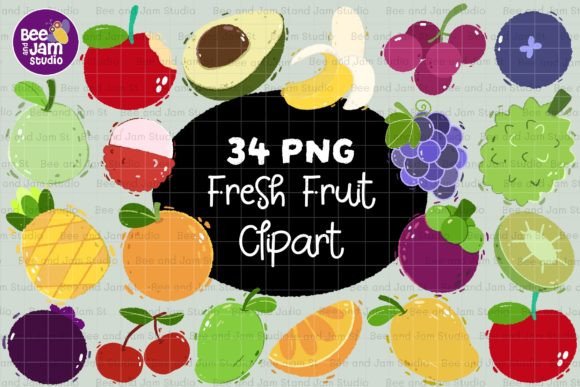
High-quality, transparent-background fruit illustrations are more than decorative assets—they’re functional tools that bridge aesthetics with utility across diverse creative and educational domains. The Fresh Fruit PNG Sublimation Clipart collection stands out not only for its botanical accuracy and vibrant color fidelity but also for its intentional versatility. Comprising 34 meticulously rendered fruits—including Apple-2, Avocado, Banana, Blackcurrant, Blueberry-4, Cherry-2, Durian, Grape-2, Guava, Kiwi, Lychee, Mango-2, Mangosteen, Orange-2, Pear-2, Pineapple, Prune, Raspberry, Rose Apple, Strawberry-3, and Watermelon—this set transcends seasonal or thematic limitations. Its design philosophy centers on adaptability: each file is crafted to serve equally well in digital planning, tactile learning, commercial printing, and hands-on classroom activities.
Why Resolution and Technical Specifications Matter in Real-World Use
The technical foundation of this collection directly influences its practical performance. Each of the 34 PNG files measures 3800×4500 pixels—equivalent to 12.6” × 15” at 300 dpi. That resolution isn’t arbitrary; it’s calibrated for real-world output scenarios. For sublimation printing on mugs, tote bags, or ceramic tiles, 300 dpi ensures crisp edge definition and color integrity even when heat-pressed onto polyester-coated surfaces. In contrast, lower-resolution assets often pixelate or blur during scaling—especially problematic when resizing for large-format applications like party backdrops or classroom bulletin boards.
The sRGB color profile further enhances consistency. Unlike Adobe RGB or ProPhoto RGB, sRGB is the universal standard for web display, digital projectors, and most consumer-grade printers. This means a watermelon illustration viewed in Canva will render nearly identically when exported to a PDF brochure or printed on a home inkjet—minimizing color-shift surprises during client handoffs or school supply runs. Transparency is baked in via alpha channels, eliminating manual background removal and reducing prep time for educators assembling printable busy books or designers building layered digital sticker sheets.
Applications Across Learning Environments and Developmental Stages
Educators—from preschool teachers to special education specialists—leverage these fruit illustrations as scaffolding tools rather than mere visuals. Because the set includes multiple variants (e.g., Strawberry-3, Blueberry-4, Mango-2), it supports comparative analysis: learners can sort by size, color intensity, skin texture, or seed visibility. In vocabulary development, pairing “Lychee” or “Mangosteen” with labeled visuals reinforces orthographic memory and phonemic awareness far more effectively than generic clipart. Similarly, “Prune” and “Rose Apple” introduce nuanced botanical terminology while expanding cultural food literacy.
For occupational therapy and fine motor skill development, the high-fidelity outlines in each PNG support precise cutting practice in laminated busy books. Unlike stylized or cartoonish alternatives, these illustrations retain realistic contours—helping children trace, color within boundaries, or match halves of symmetrical fruits like oranges and apples. In science units on plant parts, students annotate downloadable PNGs directly in PowerPoint or Google Slides, labeling calyxes, stems, and receptacles without distortion. The inclusion of less common fruits—Durian, Guava, Mangosteen—also invites cross-curricular exploration of geography, climate zones, and agricultural economics.
Design Flexibility Beyond Seasonal Greetings
While the collection is explicitly optimized for Valentine’s Day, Thanksgiving, Christmas, and Fall-themed projects, its utility extends into year-round professional workflows. Consider how “Basket-2” functions not just as holiday decor but as a structural element in nutrition curriculum materials—holding illustrated servings of MyPlate components. Or how “Pineapple” and “Mango-2” anchor tropical-themed planners for remote workers or wellness coaches, reinforcing mood-boosting visual associations without clichéd sun graphics.
In print-on-demand (POD) and T-shirt design, the absence of hard edges or drop shadows allows seamless integration into distressed textures, halftone overlays, or vintage typography layouts. A single “Blackcurrant” PNG can be recolored in Illustrator to match brand palettes, duplicated to form organic borders, or scattered as negative-space accents behind handwritten quotes. For label and packaging design, the uniform canvas size (12.6” × 15”) enables batch resizing—ensuring consistent proportions across jar stickers, tea box inserts, or bakery bag seals without individual file recalibration.
Seamless Integration Into Common Creative Workflows
Compatibility isn’t theoretical—it’s tested across platforms routinely used by non-designers. Teachers paste “Strawberry-3” directly into Microsoft PowerPoint slides for interactive drag-and-drop spelling games. Homeschoolers import “Pear-2” into Canva’s notebook templates to create personalized writing journals. Small-business owners layer “Grape-2” over textured backgrounds in Photoshop to generate social media banners for farmers’ market promotions. Even novice users benefit from the predictable sRGB + PNG + transparency triad: no color profile warnings in Affinity Designer, no rasterization prompts in Illustrator, no transparency flattening in older versions of PowerPoint.
This interoperability reduces cognitive load. Instead of troubleshooting file formats or hunting for compatible fonts, creators focus on pedagogical intent or brand messaging. A speech-language pathologist building articulation flashcards doesn’t need to adjust DPI settings—she drags “Avocado” into her document and prints. A church volunteer designing a fall-themed Bible study cover doesn’t wrestle with bleed margins—she places “Pumpkin-adjacent” fruit (though not listed, the warm-toned “Mango-2” and “Orange-2” serve the same chromatic purpose) against a neutral backdrop and exports.
Supporting Diverse Creative Outputs Without Compromise
The breadth of supported outputs reflects thoughtful categorization—not marketing padding. “Digital Sticker Planners” rely on sharp vector-like edges and moderate file weight; these PNGs average under 8 MB each, balancing quality with upload speed on mobile devices. “Background Design” demands scalability: the 3800×4500 resolution allows cropping to 16:9, square, or vertical ratios without generational loss. “Mandala Clipart” and “Seamless Patterns” benefit from the symmetrical framing of fruits like “Cherry-2” and “Raspberry”, whose natural radial structures translate intuitively into repeat tiles.
Even niche uses hold up under scrutiny. “Vocabulary Clipart” gains precision from botanical fidelity—“Guava” shows distinct seed clusters, differentiating it from “Lychee” at a glance. “School Clipart” avoids oversimplification: “Durian” retains its spiky rind texture, inviting discussion about adaptation and defense mechanisms in plants. And for “Back to School” materials, the inclusion of “Apple-2” (a culturally resonant symbol) alongside “Watermelon” and “Banana” subtly normalizes nutritional diversity beyond the traditional red apple trope.
Considerations for Ethical and Sustainable Implementation
Because this is a digital download with unlimited usage rights, creators retain full control over distribution and modification—critical for institutions adhering to copyright compliance policies. Unlike stock libraries requiring attribution or limiting commercial redistribution, this set permits embedding in paid digital products (e.g., printable activity bundles sold on Teachers Pay Teachers) without royalty calculations. However, responsible use still requires attention to representation: pairing “Rose Apple” and “Mangosteen” with culturally accurate context in lesson plans avoids exoticizing. Likewise, using “Prune” and “Blackcurrant” in health units should reference their antioxidant properties with cited sources—not just aesthetic appeal.
From an environmental standpoint, high-resolution digital assets reduce reliance on physical sample kits or printed swatch books. A graphic designer sourcing “Blueberry-4” for a sustainable food brand’s annual report eliminates shipping emissions associated with mailed proofs. A Montessori educator reusing “Kiwi” across three years of botany units minimizes paper waste compared to disposable flashcard sets.
Ultimately, the Fresh Fruit PNG Sublimation Clipart collection succeeds because it meets users where they are—not as passive consumers of decoration, but as active problem-solvers navigating constraints of time, technology, curriculum standards, and audience needs. Its strength lies not in sheer quantity, but in the intentionality behind each variant, resolution choice, and color decision. Whether anchoring a kindergarten sorting activity, elevating a boutique’s seasonal product line, or grounding a university nutrition course in visual evidence, these illustrations operate with quiet reliability—precisely what professionals require when creativity must coexist with practicality.