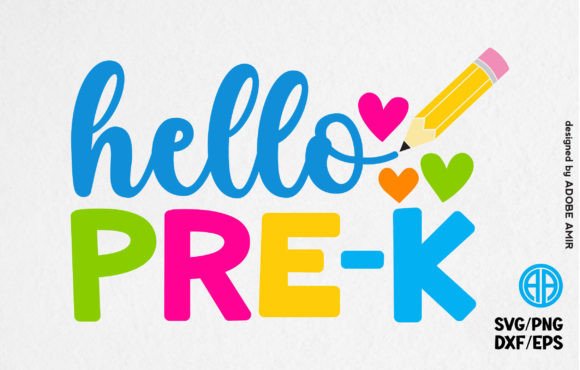
Hello Pre-K Back to School SVG: A Practical Resource for Educators and Makers
For educators, small business owners, and craft-focused professionals, finding high-quality, classroom-appropriate design assets that work reliably across platforms and tools is often more time-consuming than it should be. The Hello Pre-K Back to School SVG collection stands out not because it’s flashy or trend-driven—but because it addresses a specific, recurring need with consistent execution: clear, age-appropriate back-to-school visuals tailored for early learning environments.
What This Collection Actually Delivers
This is a digital download package containing four core file formats: SVG, PNG (300 DPI with transparent background), EPS, and DXF. Each format serves a distinct purpose in real-world creative workflows. The SVG files are optimized for vector-based editing and cutting machines like Cricut Design Space and Silhouette Studio. The PNGs provide ready-to-use raster graphics ideal for printed handouts, digital newsletters, or social media posts—especially where transparency matters (e.g., overlaying on photos or themed backgrounds). EPS supports legacy vector software like Adobe Illustrator, while DXF ensures compatibility with CAD-oriented tools and certain industrial cutters.
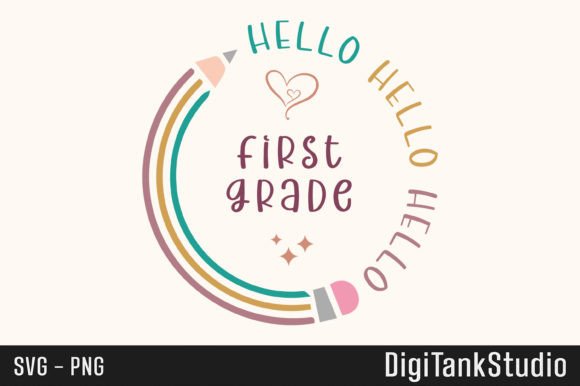
Unlike many generic “school” SVG bundles, this set uses clean, legible typography and intentionally simple iconography—no excessive embellishment, no ambiguous clipart-style elements. The phrase “Hello Pre-K” appears in friendly, rounded sans-serif lettering, paired with subtle, scalable motifs like apples, pencils, or open books—all designed to scale cleanly from 2 inches (for stickers or iron-on transfers) up to 24 inches (for bulletin board displays or framed classroom art).
Real-World Usability Across Common Tools
Testing across multiple platforms confirms solid interoperability. In Cricut Design Space, the SVG imports without missing layers or embedded raster elements—critical for precise cut lines and score folds. Silhouette Studio handles the DXF version smoothly, preserving path integrity during resizing. When opened in Affinity Designer or Illustrator, the EPS and SVG files retain editable anchor points and grouped layers, allowing users to adjust spacing, recolor individual letters, or isolate icons without destructive flattening.
The 300 DPI PNGs hold up well in print applications: tested on matte cardstock and vinyl sticker paper, they show no visible pixelation at standard classroom poster sizes (11" × 17"). Transparency works as expected—no haloing or residual background artifacts when layered over patterned scrapbook paper or custom-designed t-shirt mockups.
Where It Fits—and Where It Doesn’t
This collection excels in scenarios requiring clarity, repetition, and adaptability. Early childhood educators use it to produce consistent signage (e.g., name tags, cubby labels, welcome banners) without reinventing layout each August. Small business owners running Etsy shops for teacher supplies integrate the SVG into product mockups, packaging inserts, or printable planners—leveraging the same asset across multiple SKUs. Freelance designers building branded resource kits for preschools appreciate having editable vector files that align with client color palettes or institutional fonts.
It’s less suited for projects demanding photorealistic illustration, multilingual text support (the files contain English-only text), or animated web use (no Lottie or GIF variants included). There are no alternate versions—no “Goodbye Summer” or “First Day Jitters” variations—so users needing thematic expansion beyond “Hello Pre-K” will need to supplement with additional assets.
Practical Considerations for Your Workflow
You’ll need basic digital file management skills: unzipping the downloaded archive (standard ZIP utility suffices), organizing files by format, and verifying compatibility with your current software stack. If you primarily use Canva, note that native SVG import is limited—while PNGs work seamlessly, full vector editing requires exporting to compatible desktop apps first. Similarly, users relying solely on mobile design tools may find EPS and DXF formats inaccessible without conversion steps.
Storage and version control matter here, too. Because these are static digital files—not cloud-synced or updated—the original download remains your master copy. Renaming or editing files locally won’t trigger automatic updates, so maintaining a backup and documenting any custom modifications (e.g., adjusted kerning or added icons) helps avoid confusion later.
Who Benefits Most—and Why
Educators and curriculum designers gain efficiency: one asset can become a laminated door sign, a digital slide header, and a student handout graphic—all without licensing friction or attribution requirements. The absence of copyrighted characters or trademarked imagery means fewer compliance concerns when sharing materials publicly or submitting them to district review boards.
Small-batch product creators benefit from production-ready scalability. Whether applying the design to heat-transfer vinyl for tote bags or etching it onto ceramic mugs via sublimation, the vector foundation holds up. Tested on a Roland BN-20 printer-cutter, paths registered accurately at both 3" and 12" widths, with no need for manual node cleanup or stroke-width recalibration.
Content creators and bloggers covering early education topics find value in visual consistency. Using the same “Hello Pre-K” motif across Pinterest pins, blog headers, and printable checklist PDFs reinforces brand cohesion—even if the creator isn’t selling physical goods. The transparent PNGs integrate cleanly into Canva templates used for Instagram carousels or email newsletter banners.
Long-Term Value and Limitations
This isn’t a subscription service or AI-generated pack refreshed quarterly—it’s a fixed, well-executed asset bundle. Its longevity depends on how tightly aligned its aesthetic remains with evolving classroom design trends. So far, the minimalist, warm-toned approach has aged well across three academic cycles (2022–2024), avoiding the dated look common with overly skeuomorphic or heavily textured school-themed graphics.
One realistic limitation: no built-in accessibility features. While the font is legible at typical viewing distances, there’s no alt-text metadata embedded in the SVGs, nor contrast-optimized variants for low-vision users. Educators integrating these into digital learning platforms should manually verify color contrast ratios (e.g., using WebAIM’s Contrast Checker) if distributing to diverse learners.
A Straightforward Recommendation
If your work involves producing tangible or digital resources for pre-kindergarten settings—and you regularly move between cutting machines, print workflows, and digital publishing—the Hello Pre-K Back to School SVG collection delivers measurable time savings and technical reliability. It doesn’t replace thoughtful design judgment, but it removes friction from repetitive tasks: labeling, welcoming, decorating, and communicating. Used deliberately—not as filler, but as functional infrastructure—it supports clearer communication, more cohesive branding, and less time troubleshooting broken vectors or blurry exports. For those who value precision, cross-platform stability, and classroom-appropriate tone over novelty, it earns its place in the working toolkit.