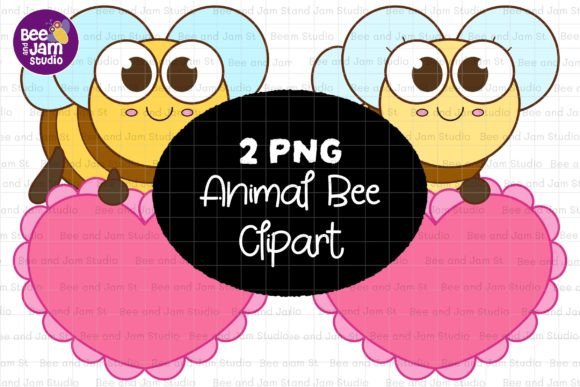
KDP Bee Animals Coloring PNG Clipart
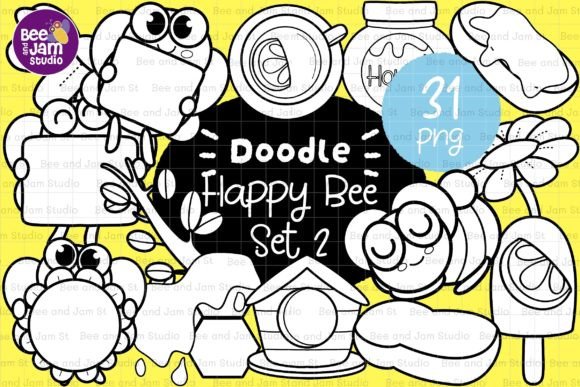
Imagine opening a ZIP file and finding 62 high-resolution, ready-to-use bee-themed illustrations—31 clean line-art outlines and 31 softly filled versions—all with transparent backgrounds, sized at 3600×3600 pixels, and optimized at 300 dpi in sRGB color space. That’s what you get with KDP Bee Animals Coloring PNG Clipart: a cohesive, professionally crafted set made in Procreate, designed not just to look charming, but to work seamlessly across real-world creative workflows.
Why This Set Fits More Than Just “Bee” Projects
At first glance, it’s a collection of kawaii-style bees—round, friendly, gently detailed, and full of quiet personality. But its versatility runs deeper. The same bee holding a tiny acorn works equally well on a fall-themed classroom poster, a baby shower invitation, or the cover of a children’s vocabulary workbook. Its clean lines make it ideal for coloring pages; its balanced proportions suit sublimation transfers; its consistent sizing and transparency mean it drops effortlessly into Canva layouts or Adobe Illustrator templates.
For Beginners: Simplicity Without Sacrifice
If you’re new to digital design—or just want to finish a project without wrestling with layers or clipping masks—this set removes friction. Every PNG opens instantly in PowerPoint, Google Slides, or Canva. No need to trace, erase backgrounds, or adjust resolution. You can drag a white-filled bee onto a greeting card background and print it the same day. For parents making busy books or teachers prepping back-to-school activities, that immediacy matters more than advanced features. It’s not about mastering software—it’s about bringing an idea to life quickly, confidently, and with warmth.
For Educators & Curriculum Designers
Classroom visuals need clarity, consistency, and age-appropriate charm. These bees aren’t overly complex (no tiny wings lost in photocopying), yet they carry enough visual interest to support storytelling, emotion recognition, or thematic units—from insect life cycles to seasonal changes. Use the outline versions for tracing practice or fine-motor skill development. Layer the white-filled versions behind text for illustrated flashcards. Pair them with simple vocabulary (“hive,” “pollen,” “nectar”) in bilingual worksheets. Because all files are 300 dpi and sRGB, they reproduce cleanly on both screen and printed handouts—no fuzzy edges, no color shifts.
For KDP Authors & Self-Publishers
If you publish activity books, journals, or early-learning titles on Kindle Direct Publishing, interior clipart must meet strict technical standards—and this set does. Each file is 12”×12”, scalable without pixelation, and built with clean vector-like edges (even as raster PNGs). That means crisp printing on Amazon’s POD services, whether your book is a 24-page toddler coloring journal or a 120-page mandala-and-bee hybrid for mindful adults. The dual-format delivery (outline + white-filled) gives you flexibility: use outlines for coloring pages, white fills for cover thumbnails or section dividers—no extra editing needed.
Real-world examples:
- A homeschool parent compiles a “Fall Nature Scavenger Hunt” PDF—drops outline bees next to leaf icons and pumpkin silhouettes, exports as print-ready PDF.
- A T-shirt designer isolates a single bee from the set, resizes it for chest placement, and uploads directly to Printful—no background removal, no color correction.
- An indie publisher building a fairy-tale themed notebook series uses the seamless potential of the bee motifs to create subtle repeating borders—not as full patterns, but as spaced, organic accents along margins.
For Small Business Owners & Makers
When you sell printable party kits, seasonal cards, or digital planners, reliability and reusability are non-negotiable. This set lets you reuse the same bee across multiple product lines—Thanksgiving place cards, Christmas ornament tags, baby shower cupcake toppers—all while maintaining visual continuity. Because you receive unlimited downloads, you can test variations (color swaps in Photoshop, layout experiments in Illustrator) without worrying about license limits. And since every file is transparent-background PNG, you avoid the time-sink of manual background removal—critical when launching five products in one week.
What Experienced Designers Notice First
Look closer: the line weight is consistent across all 31 designs, the curves are smooth but not overly rigid, and the spacing between elements (like antennae and wings) leaves breathing room for coloring or embroidery digitizing. There’s intention behind the simplicity. That makes these assets easy to integrate—not just drop in, but build upon. You can use them as base layers for textured overlays, convert them to vectors for laser cutting, or layer them into seamless patterns using offset tiling techniques. The Procreate origin ensures natural stroke variation, avoiding the sterile uniformity of auto-traced art.
Where Commercial Use Meets Practical Ethics
This isn’t clipart scraped from free repositories or AI-generated approximations. It’s original, hand-drawn work—with clear commercial licensing included. That matters if you’re selling physical goods (sublimated mugs, embroidered patches) or digital products (Canva templates, lesson plans on Teachers Pay Teachers). You’re not risking copyright claims or inconsistent quality. You’re investing in assets that reflect care—not just in execution, but in how they’ll function across your audience’s hands: a child’s crayon, a teacher’s laminator, a customer’s inkjet printer.
Does This Match Your Next Project?
Ask yourself:
- Do you need high-res, print-ready files—today—not “eventually when I learn masking”?
- Are you designing for kids, educators, or seasonal celebrations where warmth and clarity matter more than photorealism?
- Do you value having both outline and filled versions, so one purchase covers coloring pages and branded decor?
- Is your workflow split across tools (Canva for speed, Illustrator for precision, PowerPoint for classroom slides)?
If yes, KDP Bee Animals Coloring PNG Clipart meets you where you are—not as a “maybe someday” resource, but as a working tool. It doesn’t ask you to become a designer. It asks you to imagine what you’ll make next—and gives you 62 thoughtful, reliable starting points to get there.