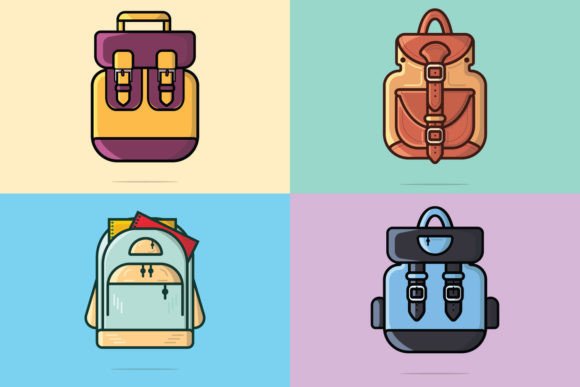
School and Traveling Bag Backpack Vector
Visual communication moves fast—and clarity matters more than ever. Whether you're designing a back-to-school campaign, launching an eco-conscious travel brand, or building educational resources for students across age groups, the right vector asset can anchor your message with instant recognition and professional polish. The School and Traveling Bag Backpack Vector collection meets that need precisely: a cohesive set of 100 high-quality, scalable illustrations that bridge two essential life stages—learning and exploring.
Why This Concept Resonates Now
Today’s audiences don’t separate education from experience. Students document field trips on social media. Remote learners pack backpacks for co-working spaces or weekend getaways. Educators integrate real-world travel themes into geography, language, and sustainability curricula. Meanwhile, travel brands increasingly highlight learning-oriented itineraries—study-abroad programs, cultural immersion tours, and language retreats. That convergence makes the School and Traveling Bag Backpack Vector more than a stylistic choice—it’s a reflection of how people actually live, learn, and move through the world.
The purple background with soft shadow isn’t just aesthetic—it signals intentionality. Purple carries associations with creativity, wisdom, and calm focus—qualities relevant to both classroom environments and mindful travel planning. The subtle drop shadow adds depth without clutter, ensuring the backpack remains legible at small sizes (think app icons or social media thumbnails) and retains visual weight in larger layouts like posters or presentation slides.
Designed for Real Workflows
Professionals aren’t just looking for pretty graphics—they need assets that integrate smoothly into existing tools and timelines. This collection delivers AI, EPS, and PDF files, each optimized for different use cases:
- AI files let designers adjust colors, paths, and layers directly in Adobe Illustrator—ideal for customizing school branding or matching a tourism company’s palette;
- EPS files offer broad compatibility across older design software and print workflows, supporting high-resolution output for brochures, banners, or merchandise;
- PDF files serve as lightweight, universally viewable previews or embeddable elements in reports, pitch decks, or internal training materials.
All 100 vectors are fully editable—no locked layers, no rasterized effects. You can recolor a student backpack to match university colors, scale a travel bag icon to fit a mobile UI, or combine multiple elements into a custom infographic about lifelong learning. That flexibility saves time and reduces dependency on external designers—especially valuable for educators building lesson plans, freelancers managing tight client deadlines, or small business owners handling their own marketing.
Evolving Expectations in Visual Content
A decade ago, clipart-style backpack icons were common—but they often lacked consistency, cultural nuance, or technical precision. Today’s users expect more: clean lines, thoughtful proportions, inclusive representation (e.g., varied strap styles, gender-neutral silhouettes, accessibility-aware design), and format reliability. The School and Traveling Bag Backpack Vector collection responds to those expectations—not by chasing trends, but by grounding its design in usability and context.
Consider how digital learning platforms now emphasize visual scaffolding: icons help users navigate modules, identify activity types (e.g., “pack your bag for today’s virtual field trip”), or signal transitions between academic and experiential content. Similarly, travel apps use consistent iconography to guide users through booking flows—backpack icons appear in itinerary summaries, packing checklist interfaces, and destination highlights. Having a unified, editable set means teams can maintain visual coherence across touchpoints without reinventing the wheel.
Practical Applications Across Roles
How does this translate beyond theory? Here’s how different professionals use these vectors in day-to-day work:
- Educators embed backpack icons into interactive worksheets—e.g., a “back-to-school scavenger hunt” where students match items to subjects, or a geography project where each country’s flag appears beside a stylized travel bag representing local culture;
- Marketing managers build seasonal campaigns around dual themes—like “Learn & Go” summer promotions—using coordinated visuals across email headers, landing pages, and Instagram carousels;
- Freelance designers create custom templates for Canva or Figma that clients can adapt themselves—adding value while reducing revision rounds;
- Small business owners print backpack vectors on reusable tote bags or water bottles as branded swag for student-focused workshops or travel meetups;
- Bloggers and content creators illustrate listicles (“10 Skills You’ll Gain While Studying Abroad”) or comparison posts (“Backpacks for Campus vs. Backpacks for Hiking”) with consistent, on-brand imagery.
None of these uses require advanced illustration skills—just access to well-structured, editable files. That lowers the barrier to professional-grade visuals, especially for solopreneurs or non-designers who still need to communicate clearly and confidently.
Supporting Modern Lifestyles—Without Overpromising
It’s tempting to frame every design asset as “revolutionary.” But what makes the School and Traveling Bag Backpack Vector genuinely useful is its restraint and relevance. It doesn’t try to be everything—it focuses on a narrow, high-frequency visual need: representing movement, preparation, and growth through the familiar symbol of a backpack.
This aligns with broader shifts toward modular, reusable content. Rather than commissioning one-off illustrations for each campaign, teams are investing in curated libraries—assets they can remix, resize, rebrand, and repurpose across channels and timeframes. A single backpack vector might appear in a back-to-school newsletter in August, a study-abroad webinar slide in January, and a sustainable travel blog post in April—all with minimal adjustments.
That kind of longevity depends on technical quality and thoughtful design decisions: consistent stroke weights, balanced negative space, intuitive grouping of elements, and formats that stay viable as software updates. These vectors were built with that durability in mind—not as disposable graphics, but as long-term creative infrastructure.
Moving Forward, Thoughtfully
As remote learning stabilizes and experiential travel rebounds, the line between “school supplies” and “travel gear” continues to blur. Students carry laptops, journals, portable chargers, and language apps—not just notebooks and pens. Their backpacks hold both textbooks and boarding passes. Design assets that reflect that reality don’t just look current—they support clearer communication, better user experiences, and more inclusive storytelling.
The School and Traveling Bag Backpack Vector collection doesn’t predict the future of education or tourism. Instead, it offers practical, grounded tools for people shaping that future today—whether they’re drafting a syllabus, designing an app interface, or planning a cross-cultural exchange program. Its strength lies not in novelty, but in quiet reliability: 100 vectors, three editable formats, one cohesive concept—ready when you are.