Set of School and Traveling Bag Backpack
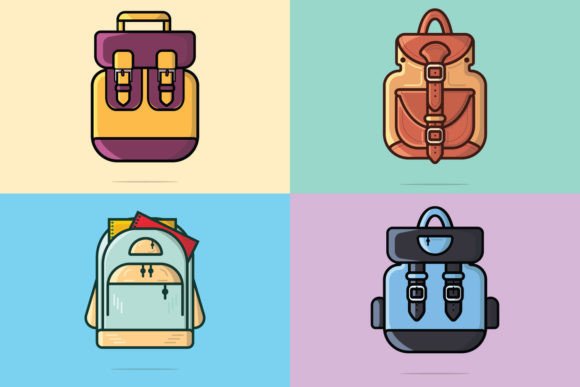
If you’ve ever spent hours searching for the right visual to represent student life, academic transition, or smart mobility—whether for a back-to-school campaign, an education app interface, or a travel-themed learning resource—you know how hard it is to find something that feels both authentic and versatile. The Set of School and Traveling Bag Backpack answers that need: a curated collection of 100 high-quality vector illustrations built around real-world objects students and travelers actually use—backpacks, tote bags, laptop sleeves, duffels, and hybrid carry-ons—all designed with clarity, consistency, and flexibility in mind.
Why This Collection Fits Real Workflows—Not Just Stock Galleries
This isn’t just another generic icon pack. Each vector in the Set of School and Traveling Bag Backpack reflects how people move between roles and spaces: a college student carrying textbooks *and* a weekend change of clothes; a teacher commuting with lesson plans, a reusable water bottle, and a tablet; a freelance educator traveling to workshops with branded merch and presentation gear. The designs avoid cartoonish exaggeration or outdated stereotypes—they show functional, modern bags with zippers, adjustable straps, side pockets, and subtle texture cues that read clearly at any size.
Because they’re delivered in Ai, EPS, and PDF formats, these vectors integrate smoothly into real production pipelines. A graphic designer can open the AI file, recolor a backpack’s strap in two clicks, and drop it into a university admissions brochure. A blogger building a “study abroad checklist” post can scale the same vector to 48px for an inline icon or stretch it across a full-width hero banner without pixelation. An e-learning platform developer can export individual elements as SVGs for responsive web use—or extract paths to animate a bag “filling up” with books in a micro-interaction.
Where People Actually Use These Vectors (and Why Timing Matters)
Educators and EdTech teams reach for this set when launching new academic calendars. Imagine updating a district’s “Back to School” portal: instead of reusing the same overused pencil-and-apple combo, you pair a clean vector of a durable backpack with a rolled-up map and a digital pass—hinting at both classroom learning and fieldwork. That small shift makes messaging feel current and inclusive.
Small business owners selling student-focused products—like eco-friendly lunch kits or ergonomic laptop stands—use these vectors to build cohesive product pages. One entrepreneur told us she replaced her stock-photo-heavy Shopify site with custom-composed scenes: a backpack open to reveal her bamboo utensil set beside a reusable bottle and notebook. Conversion rates rose because customers instantly recognized their own routines.
Freelance marketers and content creators rely on this set when deadlines are tight but brand integrity matters. Need a social media carousel about “packing for your first semester”? You don’t wait for custom illustration—just layer three backpack vectors (one packed, one half-packed, one empty), add short captions, and schedule. No licensing headaches. No mismatched styles. Just consistent, editable assets that match your voice.
Even nonprofits supporting youth mobility find value here. One after-school program used the vector of a weather-resistant backpack with external pockets to visualize their “school supply + transit pass + hygiene kit” distribution model—making grant proposals more tangible and stakeholder presentations more grounded.
What Makes These Vectors Easy to Adapt—Without Compromising Quality
“Easily editable” isn’t marketing speak—it’s baked into the file structure. Layers are named logically (strap_main, zipper_teeth, front_pocket_fill). Colors use global swatches, so changing a brand’s primary blue updates every backpack in the set at once. There are no embedded raster effects or ungrouped compound paths. If you need to isolate the front pocket of a hiking-style daypack to label it “Emergency Kit,” you can—without tracing or guesswork.
That level of control matters when context changes fast. A university communications team might use the same backpack vector in a print viewbook (at 300 DPI, CMYK), then repurpose its outline-only version for a dark-mode mobile app icon, then extract just the shoulder strap shape to create a custom divider line in a presentation deck. All from one source file.
Before You Download: Practical Things to Consider
Ask yourself: What’s the smallest size this will appear at? While all 100 vectors scale infinitely, ultra-fine details like stitching lines or zipper pulls may need simplification below 24px. The collection includes simplified variants for UI use—check the naming convention (e.g., backpack_ui_v2.ai) before finalizing.
Think about color system alignment. If your brand uses only two primary colors plus neutrals, test how the pre-built color variations translate. Most vectors include grayscale, monochrome, and 3-color options—but you’ll get more mileage if you plan to adjust fills rather than rely solely on presets.
And consider audience nuance. A backpack labeled “STEM Camp 2024” works for middle school outreach—but swap in a minimalist duffel with a passport sleeve, and it resonates more with gap-year advisors or language immersion programs. The strength of this set lies in its range—not just variety, but intentional, situation-aware design.
Real Outcomes, Not Just Assets
One community college redesigned its orientation website using this set—and saw a 22% increase in completed registration steps. Their hypothesis? Clear, relatable visuals reduced cognitive load for first-gen students unfamiliar with campus terminology. Another travel blogger used the vector of a compact backpack with detachable daypack to illustrate a “carry-on only” Europe itinerary. Her email open rate jumped because readers immediately pictured themselves in the scene—not just reading about it.
That’s the quiet power of the Set of School and Traveling Bag Backpack: it doesn’t just fill space. It supports decisions, clarifies messages, and quietly signals “we understand your reality.” Whether you’re sketching wireframes, drafting a syllabus, designing merch, or building a bilingual parent resource guide—the right bag vector, properly chosen and thoughtfully applied, becomes a small but meaningful bridge between intention and action.