School Sticker Set: A Practical Design Resource for Educators, Creators, and Small Business Owners
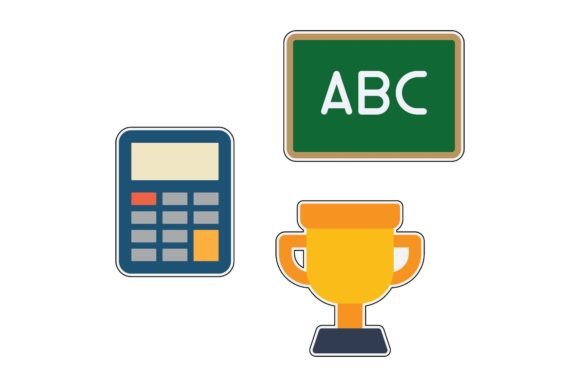
When you need to reinforce learning, energize classroom materials, or add visual consistency to educational products—without investing hours in custom design—the School Sticker Set delivers immediate, editable value. It’s not just a collection of clipart; it’s a purpose-built toolkit designed for clarity, adaptability, and real-world application. Each sticker is crafted with intention: clean lines, balanced proportions, and thoughtful iconography that supports recognition, engagement, and brand coherence—not distraction.
Why This Isn’t Just Another Clipart Pack
Most digital sticker sets fall short when used beyond casual decoration. They lack scalability, suffer from inconsistent spacing or stroke weights, or embed fonts that won’t render across platforms. The School Sticker Set avoids those pitfalls by delivering five native formats—AI, EPS, SVG, JPG, and PNG—all built at a consistent canvas size of 1920 px × 1280 px. That means whether you’re importing into Adobe Illustrator for vector refinement, embedding in Canva for quick social posts, or placing into a printed workbook at high resolution, the assets retain fidelity and flexibility.
This isn’t about convenience alone. It’s about reducing decision fatigue. When you’re preparing lesson plans, launching a tutoring service, or designing branded stationery for a homeschool co-op, time spent troubleshooting file compatibility or re-tracing low-res graphics erodes your capacity for higher-value work—like tailoring instruction or refining messaging.
Strategic Use Cases Across Roles
How you apply the School Sticker Set depends less on what it is and more on what you aim to achieve. Here are grounded examples—not hypotheticals—used by professionals who’ve integrated these assets into their workflow:
- Educators: Embedding stickers into digital exit tickets (Google Slides or PDF worksheets) to let students self-select understanding levels—e.g., a “lightbulb” for “I get it,” a “question mark” for “I’m unsure.” Consistent visual cues reduce cognitive load and accelerate feedback loops.
- Small business owners: Using SVG stickers as scalable elements in email headers, invoice footers, or packaging inserts—reinforcing tone (friendly but professional) without needing a designer on retainer.
- Freelance curriculum designers: Layering PNG stickers over editable templates to rapidly prototype differentiated activity cards—then exporting final versions with transparent backgrounds for seamless print or LMS upload.
- Bloggers and publishers: Adding subtle SVG icons beside section headers in long-form education guides—improving scannability while maintaining editorial voice and visual rhythm.
What to Consider Before You Open the Files
Having access to versatile files doesn’t automatically translate to better outcomes. The School Sticker Set amplifies intent—it doesn’t replace it. Before opening AI or SVG files, ask yourself:
- What specific communication goal does this sticker serve? Is it clarifying a concept? Guiding behavior? Reinforcing identity? If the answer is vague (“It looks cute”), pause. Visuals without function dilute impact.
- Where will this appear—and how will users interact with it? A sticker placed on a laminated behavior chart functions differently than one embedded in a mobile app interface. Scale, contrast, and context matter more than aesthetic appeal alone.
- Does this align with existing visual language? If your school uses a defined color palette or illustration style, test one sticker against current materials first. Minor edits—adjusting hue, simplifying detail, or pairing with consistent typography—often yield stronger cohesion than swapping out entire asset libraries.
Without this kind of pre-use reflection, even high-quality files risk becoming decorative clutter—occupying space without advancing understanding, trust, or action.
Editing With Purpose, Not Just Possibility
The guarantee that these designs “can be edited as needed” is meaningful only if editing serves strategy. For instance:
- Using the AI or EPS files to isolate layers and recolor individual elements ensures accessibility compliance (e.g., sufficient contrast for learners with low vision).
- Exporting SVG versions with simplified paths reduces file size for web use—critical if embedding interactive learning modules where load speed affects engagement.
- Converting PNGs to grayscale before printing on budget-friendly inkjet printers maintains legibility while cutting costs—especially relevant for after-school program handouts or parent newsletters.
Each edit should trace back to an observable outcome: faster comprehension, broader reach, lower production friction, or improved retention. If the change doesn’t connect to one of those, it may be optimization theater—not real progress.
Risks of Unintentional Use
There’s real risk in treating the School Sticker Set as a “filler” solution. Overuse—slapping stickers onto every slide, worksheet, or email—creates visual noise that competes with core content. Learners ignore repeated symbols; customers skim past undifferentiated visuals. Worse, inconsistent application (e.g., mixing sticker styles with custom illustrations or stock photos) subtly undermines credibility—suggesting haphazard planning rather than considered design judgment.
Similarly, assuming all formats work equally well across tools leads to avoidable setbacks. JPGs lack transparency—so they’ll obscure underlying text or colors in layered documents. Relying solely on PNGs for large-format printing may result in pixelation. Knowing when to choose SVG over EPS—or why AI files give you precision control while PNGs offer plug-and-play simplicity—is part of using the set responsibly.
Long-Term Value Beyond the First Download
The durability of the School Sticker Set lies not in novelty but in repeatability. A well-chosen sticker—like a “checkmark + star” combo for mastery tracking—can become a recognizable motif across years of materials. That builds continuity for students, reinforces institutional memory for staff, and strengthens brand recognition for private educators or edtech micro-businesses.
More importantly, it frees mental bandwidth. When you’re no longer reinventing basic visual scaffolding for every new unit or campaign, you redirect energy toward deeper work: analyzing student data, refining assessment methods, or developing nuanced parent communication strategies.
That shift—from tactical execution to strategic thinking—is where the real ROI emerges. Not in how many stickers you use, but in how much more you’re able to do with the time and focus those stickers help preserve.
Making Your Next Move Intentional
If you’ve already purchased the School Sticker Set, don’t default to browsing thumbnails. Instead:
- Start with one recurring need—e.g., “I spend too long formatting weekly homework reminders.”
- Select three stickers that directly support that task (e.g., calendar, pencil, book icons).
- Edit them once—recolor, resize, group—to match your current template—and save that version as your new baseline.
- Use that baseline for two weeks. Track whether it reduced prep time, improved student response rates, or clarified expectations.
Iterate from evidence—not assumption. That’s how a simple asset becomes a lever for measurable improvement.
Thank you for visiting our shop—and for approaching design not as decoration, but as deliberate support for your goals, your people, and your work.