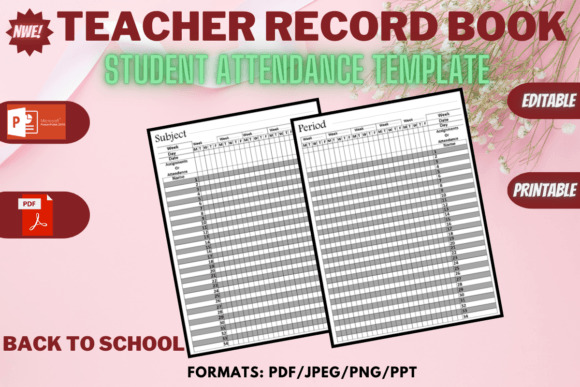
Teacher Record Book Back to School: A Flexible, Digital Foundation for Classroom Accountability
As the new academic year begins, educators across grade levels and subject areas face a shared challenge: maintaining accurate, accessible, and actionable records—whether tracking who walked through the classroom door or which students submitted last week’s science lab report. The Teacher Record Book Back to School isn’t another static binder or fragmented spreadsheet—it’s a purpose-built digital toolkit designed around real classroom rhythms. At its core lies the Editable Student Attendance or Assignments Worksheet, a single, adaptable record-keeping system that shifts seamlessly between two critical functions: daily attendance logging and assignment tracking.
How It Works: One Template, Two Essential Functions
The RECORD BOOK operates on a simple but powerful principle: structure without rigidity. Each worksheet page follows a consistent, teacher-tested layout—Subject | Week | Day | Date | Period—followed by a customizable column labeled either Attendance or Assignments. This dual-purpose design eliminates the need to toggle between separate tools or maintain parallel logs. A middle school math teacher might use Monday’s sheet for roll call and Wednesday’s for checking completion of slope-intercept practice problems. A high school English instructor could alternate weekly: one week focused on participation and punctuality, the next on draft submissions for persuasive essays.
What makes this more than just a formatted grid is its intentional flexibility. The “Name” field isn’t locked to alphabetical order—it accommodates seating charts, small-group rotations, or even hybrid cohorts where in-person and remote learners appear side-by-side. Teachers using differentiated instruction can add brief status codes (e.g., “R” for re-submitted, “P” for pending revision, “✓+” for exemplary work) directly in the assignment column—no extra columns required, no formatting breaks.
Digital Formats That Fit Real Workflows
This isn’t a one-size-fits-all PDF that resists editing. The RECORD BOOK ships as a curated collection of editable files—PDF, JPEG, PNG, and PPT—all bundled in a single ZIP folder. That variety matters because teachers don’t operate in a single software ecosystem.
- PDF versions are optimized for annotation: open in Adobe Acrobat, GoodNotes, or Notability, then type names, check boxes, or add handwritten notes with a stylus—ideal for iPad-based instruction or printed backups.
- JPEG and PNG files serve as clean, high-resolution backgrounds for digital whiteboards (like Miro or Jamboard) or learning management system (LMS) pages. A science teacher might drop the “Biology – Week 3 – Lab Report Due” PNG into a Google Classroom announcement, then ask students to self-report submission status via emoji reactions.
- PPT slides transform the record book into an interactive classroom tool. Insert live timers, embed quick rubric anchors, or convert assignment rows into clickable navigation buttons linking to Google Forms or Turnitin submission portals.
This multi-format approach respects how educators actually work—not how software vendors assume they should. It avoids vendor lock-in and supports low-bandwidth environments (a lightweight PNG loads faster than a cloud-dependent app), while still enabling rich interactivity where infrastructure allows.
Real-World Use Cases Across Teaching Contexts
The strength of the Teacher Record Book Back to School lies in its quiet adaptability—not flashy features, but thoughtful accommodations for complexity.
For Special Education Teams: Co-teachers and paraprofessionals often manage overlapping service schedules. Using the “Period” field to denote not class period but intervention block (e.g., “Speech – Block 2”, “OT – AM”), the same worksheet becomes a shared accountability log. Color-coded initials in the attendance column (“J” for Janice, “M” for Marcus) let multiple staff update presence without overwriting each other.
In Project-Based Learning Environments: Long-term assignments—like a 6-week community mapping project—don’t align neatly with daily periods. Here, the “Week” and “Subject” headers become anchoring points, while the “Assignments” column evolves into a progress tracker: “Research phase complete”, “Interviews scheduled”, “Draft outline reviewed”. The date field shifts from calendar day to milestone deadline, turning the record book into a visible project dashboard.
For Substitute Teachers: Clarity under time pressure is non-negotiable. A pre-filled RECORD BOOK sheet—printed or loaded onto a tablet—gives subs immediate context: which students are regularly absent, which assignments were due yesterday, which period includes a scheduled IEP review. No deciphering cursive notes or hunting through nested folders.
Why Editability Matters More Than Automation
Many digital gradebooks promise “auto-syncing” and “AI-powered insights”—yet struggle with edge cases: a student who attended homeroom but missed chemistry due to a counseling appointment; an assignment revised three times with different due dates; a group project where only two of four members submitted individual reflections.
The editable nature of this Teacher Record Book Back to School places judgment—and nuance—back in the teacher’s hands. There’s no algorithm deciding whether “late by 47 minutes” counts as present or absent. No machine misreading “see comment” as “incomplete”. Instead, the teacher uses the space intentionally: a slash through a name with “Tardy – bus delay”, a circled “✓” with “Resubmitted 9/12”, or a sticky-note icon drawn beside a name indicating “Needs scaffolding—check in Friday.”
This human-centered design also supports professional reflection. At month’s end, scanning a series of weekly sheets reveals patterns invisible in aggregated dashboards: Are absences clustering on Wednesdays? Does assignment completion dip after long weekends—or spike when rubrics are co-created with students? These observations inform not just interventions, but curriculum adjustments and departmental conversations.
Implementation Without Overhead
Adopting the RECORD BOOK doesn’t require training modules or data migration. Because it’s delivered as ready-to-use files—not a subscription platform—it integrates immediately:
- Select the format matching your primary device (e.g., PDF for iPad + Apple Pencil).
- Customize one sheet: rename “Subject”, adjust “Period” labels to match your bell schedule, add your roster.
- Replicate that sheet across weeks—no rebuilding from scratch.
- Archive completed weeks as dated PDFs or rename PPT files (“Chemistry_Wk1_Attendance”, “Chemistry_Wk2_LabReports”).
No syncing delays. No login failures during first-period chaos. No privacy concerns about student data residing on third-party servers. And because all files are locally editable, schools with strict IT policies—or limited edtech budgets—can deploy it district-wide tomorrow.
Design Choices That Reflect Classroom Reality
Look closely at the layout, and you’ll see pedagogical intention behind the pixels. The “Day” field appears before “Date” because teachers think in weekly cycles (“Is today Thursday?” matters more than “Is it September 12?”). The “Period” column sits adjacent to “Attendance/Assignments”, not buried at the far right—reducing eye movement during rapid scanning. Font size and cell spacing accommodate both typed entries and legible handwriting. Even the ZIP folder structure is deliberate: subfolders labeled “Attendance_Focus” and “Assignment_Focus” help users navigate without opening every file.
These aren’t aesthetic flourishes. They’re responses to years of observing how educators interact with paper and screen—how fatigue affects accuracy at 3:45 p.m., how cognitive load increases when switching contexts, how clarity prevents miscommunication with families during conferences.
Beyond Compliance: Building Consistency With Purpose
Attendance logs and assignment trackers are often framed as compliance tools—necessary for audits, funding reports, or parent inquiries. But the Teacher Record Book Back to School reframes them as instruments of consistency, not just counting. When a student sees their name marked “Present” every day—even on low-energy days—they internalize belonging. When an assignment column shows steady “✓” marks across weeks, it builds academic identity. When a teacher reviews six weeks of data and notices a student’s attendance improves after joining the robotics club, that’s insight—not bureaucracy.
This consistency extends to collaboration. Department chairs can request anonymized weekly snapshots (“Just the Biology 101 attendance trends for Weeks 1–4”) without exposing rosters. Instructional coaches use completed assignment sheets to identify where scaffolding broke down—not just *that* work wasn’t submitted, but *which step* in the process stalled.
In an era of escalating demands on teacher time, the value isn’t in doing more—it’s in doing what matters, clearly and sustainably. The Teacher Record Book Back to School delivers that balance: structured enough to ensure reliability, flexible enough to honor complexity, and digital enough to move at the speed of teaching—not software development cycles.