School Items Flashcards – Back to School
Imagine walking into a classroom on the first day of school and seeing a child confidently point to their pencil, name their notebook, and describe what a protractor does—all before recess. That kind of ease doesn’t happen by accident. It grows from simple, consistent exposure to everyday learning tools. School Items Flashcards – Back to School are designed for exactly that: helping children build familiarity, confidence, and language around the physical objects they’ll use daily in the classroom and beyond.
What Makes These Flashcards Different?
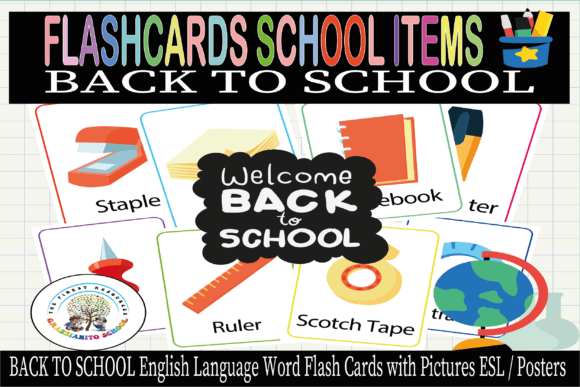
These aren’t generic vocabulary cards with clipart and thin fonts. Each card features a bold, realistic illustration of a common school item—like a glue stick, scissors, or a three-ring binder—paired with clear, easy-to-read labeling. The design is intentionally vibrant but not overwhelming: high-contrast colors support visual processing, while clean layouts reduce cognitive load for emerging readers and English language learners alike.
Unlike flashcard sets that focus only on nouns, this collection supports functional understanding too. Many educators use them to spark conversations like, “What do we use a ruler for?” or “Why do we keep pencils in a pencil case?” That subtle shift—from naming to using—turns passive recognition into active thinking.
Who Benefits—and How?
Teachers find these especially helpful during the first two weeks of school, when routines are still settling and students are adjusting to new spaces and expectations. A quick 5-minute “flashcard match-up” game at circle time builds shared vocabulary without pressure. In small groups, students can sort cards by category (writing tools, storage items, art supplies) or sequence them by size or function—practicing classification and reasoning skills alongside language.
Parents use them just as effectively at home. Laying out 10 cards on the kitchen table while packing a backpack turns routine prep into low-stakes practice. Homeschoolers integrate them into morning meetings or pair them with sensory bins (e.g., matching a “scissors” card to actual safety scissors and fabric scraps). Tutors weave them into speech therapy goals—targeting articulation, sentence formulation, or auditory memory—with no extra prep needed.
Real-Life Uses You Can Start Today
- Classroom warm-ups: Hold up a card and ask, “What’s one thing you use this for?” Rotate through 3–4 cards daily to build momentum without repetition fatigue.
- Backpack scavenger hunt: Give students a printed checklist with 6 flashcard images. They search their own backpacks to find real-life matches—reinforcing object permanence and self-management.
- Labeling stations: Print and laminate cards, then place them beside corresponding supplies in your classroom supply center. Students learn where things belong—and how to ask for them correctly.
- Home-school transitions: Send home a set of 8 cards each week leading up to school start. Families snap photos of their child holding the real item, creating a personalized “school supply journal.”
More Than Just Vocabulary—It’s Confidence Building
For children who’ve had limited preschool exposure—or those navigating a new language or school system—knowing the names of everyday tools reduces anxiety. When a student can say “eraser” instead of pointing silently, they’re more likely to ask for help, join group tasks, and participate in lessons. That small linguistic step supports social-emotional growth, classroom engagement, and academic readiness all at once.
Even older learners benefit. Second- and third-graders use the cards to practice descriptive language (“The ruler has numbers and lines”) or compare features (“A mechanical pencil doesn’t need sharpening, but a wooden one does”). Special educators adapt them for AAC support or as visual anchors during multi-step instructions.
Things to Keep in Mind Before You Begin
Not all flashcards work the same way for every learner. Consider these practical points before choosing or using School Items Flashcards – Back to School:
- Age alignment matters. Preschoolers respond best to single-object cards with minimal text; early elementary learners benefit from added context (e.g., “used for measuring” or “keeps papers together”). Check whether your set includes adaptable versions.
- Durability counts. If cards will be handled daily by young children, opt for laminated or thick-stock versions. Flimsy paper wears quickly—and frequent replacement adds cost over time.
- Look for teaching notes. The most effective sets include simple suggestions—like extension questions or activity ideas—so you don’t have to invent everything from scratch.
- Consider accessibility. Do illustrations clearly show item details? Are fonts large and sans-serif? Is color contrast sufficient for students with visual differences? These details impact real-world usability.
Finally, remember: flashcards are tools—not magic. Their value multiplies when paired with real experiences. Holding a real glue stick while looking at its card makes the connection stick. Drawing a picture of a backpack after studying the card deepens retention. Talking about why we need both a pencil *and* an eraser builds critical thinking far beyond rote memorization.
Whether you're setting up your first classroom, supporting a child’s transition to kindergarten, or designing inclusive learning materials for a tutoring business, School Items Flashcards – Back to School offer grounded, joyful, and quietly powerful support. They meet learners where they are—and gently guide them toward independence, one familiar object at a time.