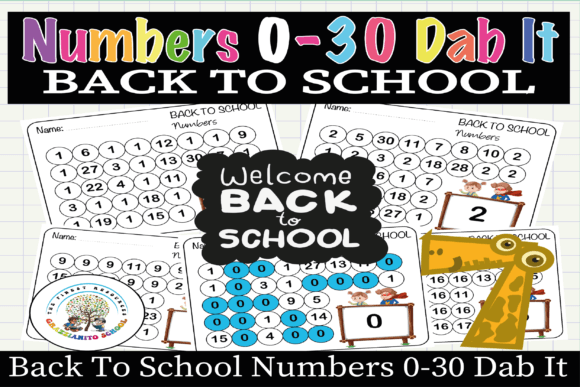
Back to School Numbers 0-30 Dab It
If you're an educator, homeschool parent, or early childhood specialist preparing for the new school year, you’ve likely seen dozens of “number recognition” printables—but not all deliver real learning value. The Back to School Numbers 0-30 Dab It activity stands out because it’s intentionally designed—not just themed—for developmental progression, sensory engagement, and classroom-ready usability. It’s more than a coloring sheet with numbers: it’s a tactile, visual, and cognitive tool that supports number fluency from zero through thirty, a critical range where many young learners begin bridging rote counting to true quantity understanding.
Why This Resource Fits Real Teaching Needs (Not Just Seasonal Aesthetics)
A common oversight is assuming any back-to-school-themed number activity will automatically support skill-building. In reality, many resources stop at surface-level recognition—showing a numeral and asking kids to trace or color it—without reinforcing one-to-one correspondence, subitizing, or number relationships. The Back to School Numbers 0-30 Dab It avoids this by embedding purposeful variation: some pages ask students to dab the numeral that matches a ten-frame; others require dabbing the number that comes before or after a given number; still others integrate simple addition (e.g., “Dab the number that is 5 more than 12”). This layered design means the same child can use the pack across weeks—not as repetition, but as increasing challenge.
Mistake #1: Assuming “0–30” Means Uniform Difficulty Across All Numbers
Many users assume coverage up to 30 implies equal readiness across the range. But research shows children often grasp 0–10 confidently, waver between 11–20 (especially teens), and struggle significantly with 21–30 due to irregular naming (“twenty-one” vs. “thirty”) and place-value abstraction. A poorly structured resource might present all numbers in identical formats—making 27 feel no different from 7. The Back to School Numbers 0-30 Dab It addresses this by grouping numbers strategically: early sheets focus on 0–10 with concrete visuals (dots, fingers, tally marks); mid-range sheets (11–20) emphasize teen patterns and base-ten structure; later sheets (21–30) introduce decomposing (e.g., “24 = 20 + 4”) alongside dabbing tasks. If your current resource doesn’t scaffold this way, you’re likely overestimating retention—or under-supporting conceptual leaps.
Mistake #2: Overlooking Print & Prep Practicality
It’s easy to get drawn in by vibrant previews—only to discover the PDF has tiny fonts, low-contrast text, or non-standard margins that waste ink or require awkward trimming. Worse, some packs include unnecessary clipart that distracts rather than supports focus. Before downloading or purchasing, check three things: First, open a sample page at 100% zoom—can you read numerals and instructions clearly without squinting? Second, verify the file uses standard letter-size (8.5" x 11") formatting with at least 0.5" margins. Third, scan for redundant elements: Does every page include a decorative border that eats into usable space? The Back to School Numbers 0-30 Dab It prioritizes functional design—bold numerals, high-contrast backgrounds, and clean layouts that print crisply on basic inkjet printers. No cutting. No adjusting. Just print, gather dabbers (bingo daubers, dot markers, or even small stickers), and go.
Mistake #3: Using It Only as a “Filler” Activity
This is perhaps the most frequent missed opportunity. Because dabbing feels playful, adults sometimes relegate it to “free time” or “early finisher” status—missing its potential as formative assessment. Each dabbed response is data: Did the child dab 16 when shown a group of 17 dots? Did they skip 29 entirely? Tracking patterns across multiple sheets reveals misconceptions faster than verbal questioning alone—especially for shy or language-emerging learners. Try this instead: Use one sheet per week as a quick 5-minute warm-up. Keep a simple checklist beside your teaching station—note which numbers consistently get missed or confused. That list becomes your next small-group focus, not guesswork.
What to Check Before You Commit
- File format & compatibility: Ensure it’s a PDF (not JPEG or ZIP-only) that opens reliably on both Windows and Mac devices—and that it includes clear printing instructions.
- Scope of differentiation: Look beyond “includes numbers 0–30.” Does it offer varied response types (matching, sequencing, comparing) and support for ELL or special needs learners (e.g., visual cues, reduced text load)?
- Real-world usage notes: Reputable creators often include brief implementation tips—like recommended dabber types, storage suggestions (sheet protectors + dry-erase markers work well for reuse), or extension ideas. Absence of these may signal a lack of classroom testing.
- Licensing clarity: If using in a school or co-op setting, confirm whether the license permits multiple teachers or only single-user access. Some sellers bury restrictions in fine print.
Better Than “Just Another Number Pack”
The Back to School Numbers 0-30 Dab It earns its place because it respects how young brains learn: not in linear, isolated chunks, but through repeated, varied, sensory-rich exposure tied to meaning. It doesn’t assume prior knowledge—and it doesn’t plateau once basics are covered. When used intentionally—as part of a broader numeracy routine, not a standalone novelty—it builds flexible number sense that transfers to problem-solving, measurement, and early operations. And because it’s grounded in early math standards (CCSS K.CC.A.1, K.CC.B.4, K.NBT.A.1), you’re not just keeping kids busy—you’re laying groundwork that matters.
If your goal is meaningful, low-prep, high-engagement number practice that grows with your learners—not one that collects dust after week two—this is the kind of resource worth selecting with care. Choose wisely, use deliberately, and watch confidence rise—one dab at a time.